Raphael KatzService & Product Designer Back to the filing cabinet

The rental application, on both sides of the listing

An application tenants fill in once and attach to their enquiries, and a table where landlords compare their applicants.

62,700applications created in the first year
15%of enquiries to private landlords sent with an application
April 2021 to April 2022, web and app, SeLoger data.
For
, private rentals squad: 2 PMs, 4 to 6 developers
When
2021: two design sprints in January and February, live in April. App in January 2022.
My role
Sole designer on the project: co-facilitated the landlord sprint, interviews, prototypes and tests, web and app mock-ups, post-launch follow-up
Status
In production since April 2021. The demo is based on my mock-ups, rebuilt in 2026, with a few additions flagged in the Trade-offs.

01Problem

A market to win, two people to convince

Most rentals happen directly between private individuals. On SeLoger, those listings were still rare: the site belonged first and foremost to estate agencies. For the squad, it was a new market.

60%
of rentals happen between private individuals
11.7%
of SeLoger rental listings came from private landlords
Design sprint brief, February 2021, SeLoger data.

These landlords were already publishing on Leboncoin or PAP. SeLoger was betting on its reputation as a serious website, the leader for agency listings, and the tenants we interviewed were precisely looking for a trusted third party. We had to give landlords a reason to publish with us.

We bet on an application with no documents. Documents are still requested, but later: the landlord first picks four or five applicants based on what they declare, and only reads their supporting documents.

What each side goes through, face to face
The future tenantThe landlord
time Has to move fast: in high-demand areas, a landlord finds a tenant in under a week. Gets a flood of enquiries as soon as the listing goes live, by phone, email or messaging, many of them simple questions: hard to keep up.
the application Wants to stand out among all the enquiries, and fears an incomplete application will rule them out. Sorts through applications that are incomplete or don’t meet the criteria.
trust Fears identity theft. Worries about late payments, like 66% of landlords.
Sprint interviews and tests; landlord sprint brief and landlord survey, SeLoger data.

The two sides mirror each other: what one fills in, the other reads. We designed them in parallel, with a design sprint for each.

02Tenant

Standing out fast, without providing supporting documents

Future tenants fill in their application in five minutes and attach it to their enquiries. The screens are in French, as on SeLoger.

The future tenant’s journey, on mobile

  1. Offered at the right moment

    In the contact form, just as they write to the landlord.

  2. Five minutes, no documents

    What to know before starting.

  3. Alone, as a couple or flatsharing

    One block per person, with their income.

  4. Optional guarantors

    Recommended, with Visale, the state-backed guarantee, for those who have none.

  5. Attached in one click

    The application goes with the enquiry, and the tenant can withdraw it.

  6. Editable at any time

    They see their application as the landlord does, and can edit every section.

Fictitious data, nothing is sent.

03Landlord

Every application in one place, on equal terms

Landlords find their applicants in a single table. They filter on their criteria, shortlist, then ask the shortlisted applicants for their documents.

We chose to filter without ranking. No column can be sorted: an income of €4,000 doesn’t jump ahead of an income of €3,900. Every applicant who meets the criteria stays on an equal footing, in the order they arrived.

The landlord’s space, on desktop

  1. Everything in one place

    All applications, each with its file.

  2. Filter without ranking

    By income, household or guarantors.

  3. Shortlist, then ask for documents

    The applicant’s profile, and the star to keep them.

Fictitious data, nothing is sent.

04Results

What tenants say about it

4/5
rating given to the application by tenants
“A first impression without giving away too much.”A tenant, in 2022
Rating recorded in April 2022, web and app, SeLoger data.

In detail

How we got there

The two design sprints, the trade-offs and what I take away from them.

05Approach

Two design sprints, then a year of follow-up

2021: one sprint for each side

Each sprint lasted five days: one day to understand the problem (users, business, behaviours, journey), two for the journey, the benchmark, wireframes, wording and mock-ups as realistic as possible, and two to test and adjust. I took part in the tenant sprint and co-facilitated the landlord sprint, where speakers brought in context: legal, a study on tenant applications, Immowelt.

  1. 26 Jan – 4 Feb

    Future tenants sprint

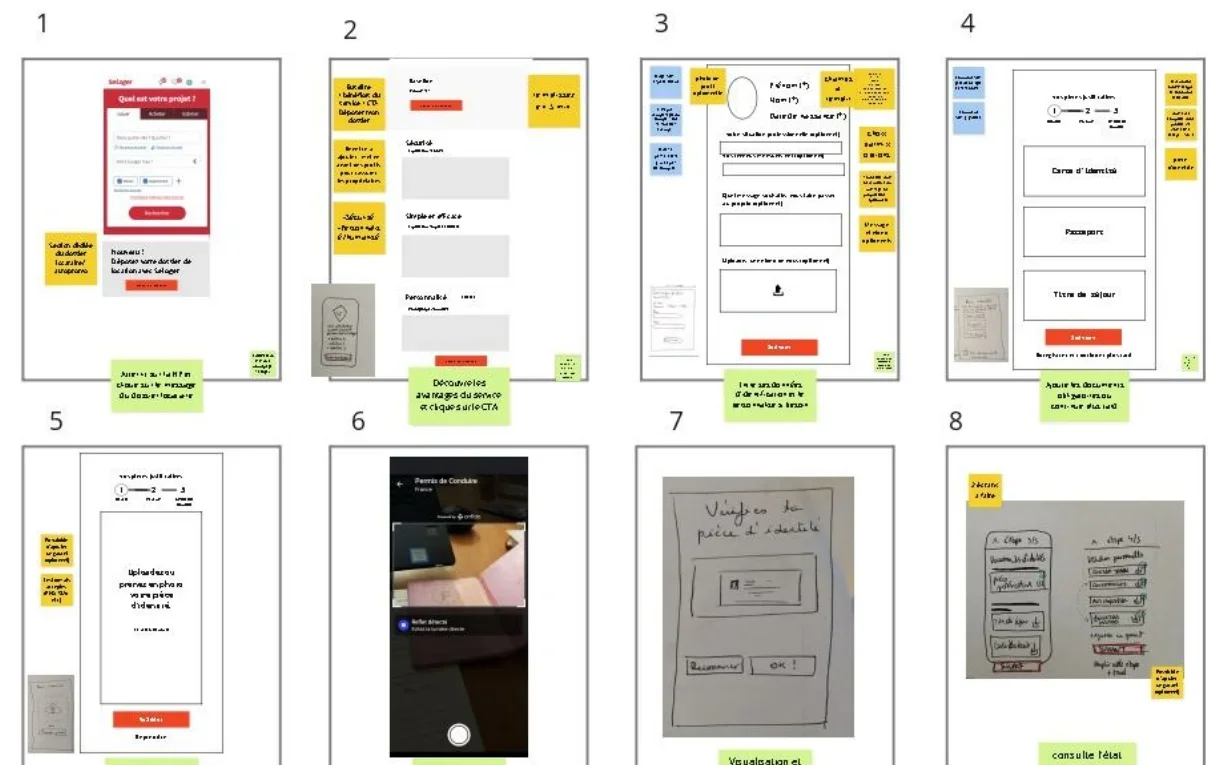
    Storyboard of the tenant prototype: the form, choosing and photographing the ID document, then tracking the application
    The prototype storyboard, before testing
    Before
    5 tenants interviewed
    Prototype
    The application on mobile, with photos of the supporting documents
    Tests
    8 tenants

    A journey seen as simple, but words that got mixed up (application, summary, documents), the feeling of giving the same information twice, and one question: what does SeLoger do with our documents?

  2. In between

    Documents are no longer checked on submission.

  3. 16 – 25 Feb

    Landlords sprint

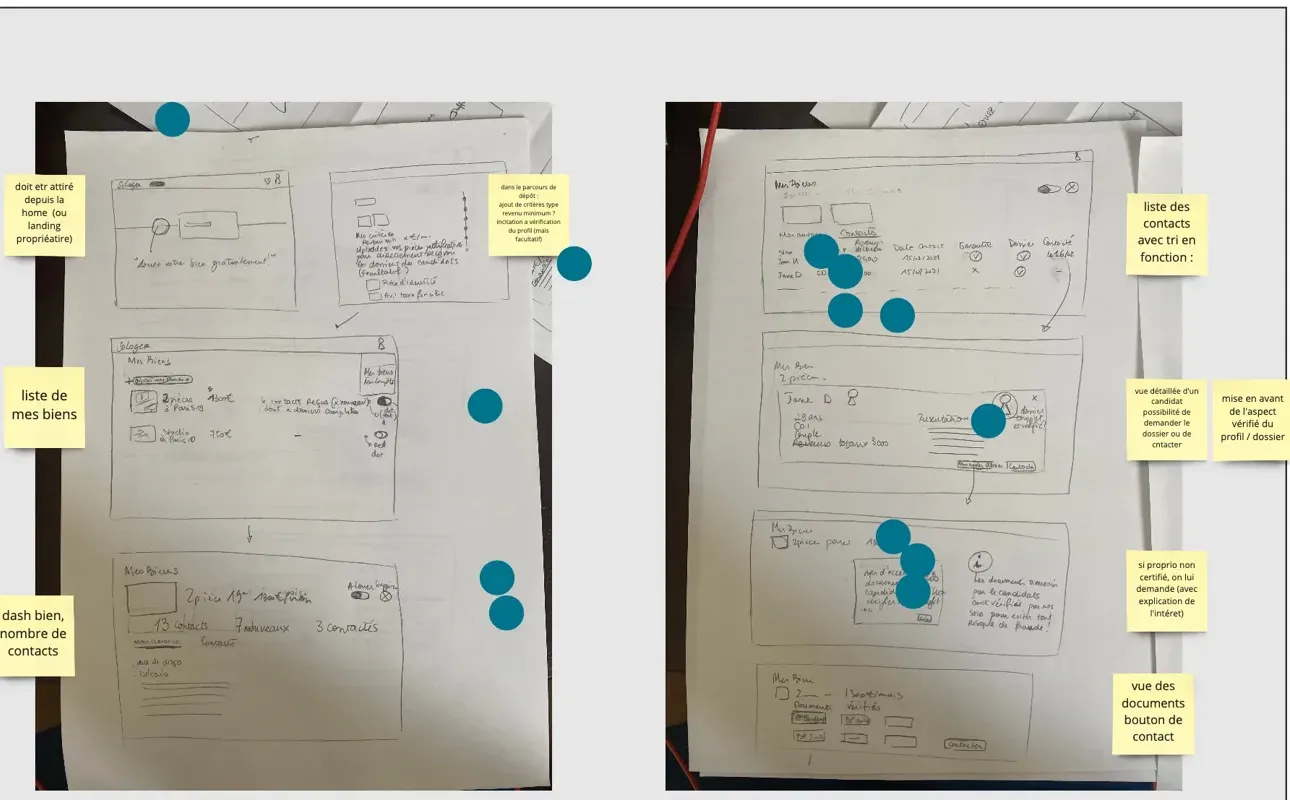
    Paper sketches of the landlord space annotated during the vote: list of properties, list of applicants, an applicant’s profile
    Sketches of the landlord space, after the vote
    Before
    5 landlords interviewed
    Prototype
    A table of applications on desktop, then each applicant’s profile
    Tests
    7 landlords

    The table saves time, and everyone uses it their own way: reading everything, shortlisting, or filtering. “It’s like an Excel sheet I don’t have to fill in.”

  4. Before April

    Before the high season, documents are taken out of the application: it becomes declarative.

  5. April

    The application and the landlord space go live on the web.

After the second sprint, we split the product into releases. The first: receiving applications, seeing them all in one place, filtering them, opening an applicant’s profile and contacting them.

A year later, feedback showed its limit: the application can only be sent to private landlords’ listings, 17% of rental listings. The next goal was to double the share of messages sent with an application, by offering it in more places and at the moment of contact.

2026: both journeys rebuilt

I rebuilt the tenant journey and the landlord space in Figma, with a design system shared with the listing flow, then coded this page’s demo from those components.

06Trade-offs

What the two sprints settled

kept

An application without supporting documents

Because tenants asked what would be done with their documents: “What could put me off is security. Where is it stored?” No document travels through SeLoger: the landlord only asks for them from the applicants they shortlist.

dropped Supporting documents in the application, because SeLoger could neither store nor verify them.

kept

An incomplete application can still be sent

Only income is mandatory. Guarantors and the introduction are optional: without them, the application still goes out, it just has less chance of being chosen.

kept

Order of arrival, no ranking by income

Because after the landlord sprint, we had made a note not to help rule out lower salaries.

dropped The applicant’s photo and video, because of the discrimination people feared during the tenant sprint tests.

kept

Couples and flatshares

Because they were poorly covered in the tests. Everyone gets their own block: one per person, with their income and their guarantors.

kept in 2026

The “Complete application” badge

Because it only says what is true: every section is filled in. The demo also adds Visale, a more visible card for the attached application and colour tags in the list.

dropped “Verified profile”, because there is no verification: SeLoger checks no documents.

07Lessons

What I take away

A service only counts where people come across it: however well designed, the application stayed little used as long as it only appeared on some listings.

Next project
INTI — From receipt to plate →
↑ Back to top