Raphael KatzService & Product Designer Back to the filing cabinet

From receipt to plate

Helping people eat better: a seasonal tip on the back of the till receipt, and the detail of the basket in the app for those who want to go further.

Back of a receipt, “Conseil du moment” (tip of the moment): “Les courges font leur entrée !” (squash season is here), with an engraving of a red kuri squash and a QR code
On the back of the receipt
In the app
For
Carrefour Innovation
When
2019: research, sprint, tests
2026: app redesign
My role
Service designer, design lead: from research to customer tests in 2019, with the idea of reading levels, then the app redesign in 2026.
Status
Tested with customers in 2019, stopped before roll-out. App redesigned in 2026, not yet tested.

01Problem

Helping people eat better, each in their own way

In 2018, Carrefour launched Act for Food, to “lead the food transition for everyone”. We started from the till receipt: every customer received one at the time, and it says exactly what they have just bought.

Across 150 real receipts, two figures stand out.

66%
of baskets average a Nutri-Score of C, the middle of the scale
36%
of products have no score (fresh produce, bakery, deli, alcohol)

Baskets have room to improve, but a score alone is not enough.

The interviews brought out three attitudes towards nutrition.

In control

Sets their own rules and follows the guidelines.

Easy-going

Looks for balance and allows themselves treats.

Resistant

Takes any score as an intrusion.

“If I pay attention to it, it’s in spite of myself. I’m not interested, especially if it’s forced on me.”A customer interviewed in 2019

A single score cannot speak to all three. Hence the idea of reading levels: everyone stops wherever they like, and someone who wants no scores at all can hide them.

02Solution

Five levels, from the paper receipt to the seasonal magazine

The first one is read on paper, the next four in the app. The app screens are in French.

  1. The paper receipt

    On the back of the receipt, a tip about a seasonal product.

  2. The receipt in the app

    One scan of the QR code, and the receipt opens with its Nutri-Scores.

  3. Alternatives

    A better-rated alternative, with the price difference.

  4. Planet

    What the receipt says about the environment, in simple markers.

  5. La Saison

    A weekly magazine, read before the next shop.

Your turn

Everything is clickable: scan a receipt, open the alternatives, browse La Saison.

Fictitious store, real products. Photos: pngimg.com (CC BY-NC 4.0), Journal des Femmes, Marley Spoon, Supertoinette, Leukerecepten, Mes Recettes Faciles, Terre & Cité, Chronodrive.

In detail

How we got there

The approach, the trade-offs and what I take away from it.

03Approach

From research in 2019 to the redesign in 2026

2019: as a team, at Carrefour Innovation

There were two of us designers, one specialised in cooking and nutrition, working with a PM. I came up with the reading levels and designed the app.

13
interviews: 8 customers and 5 checkout staff
11
people from six departments, for a 4-day design sprint
4
customers tested the prototype on the last day

They liked a concise service, with no sign-up, where everyone chooses how far to go: “a suggestion more than an obligation”. They also showed its limits, which shaped the trade-offs: the advice came after the checkout, the QR code was rarely used, and price came first.

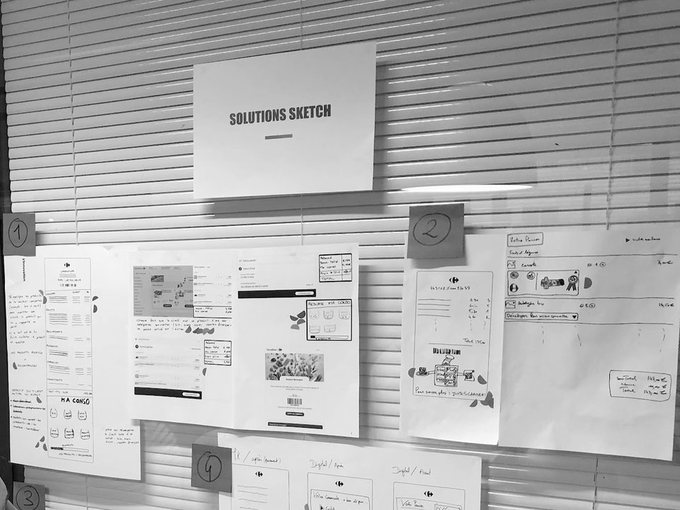
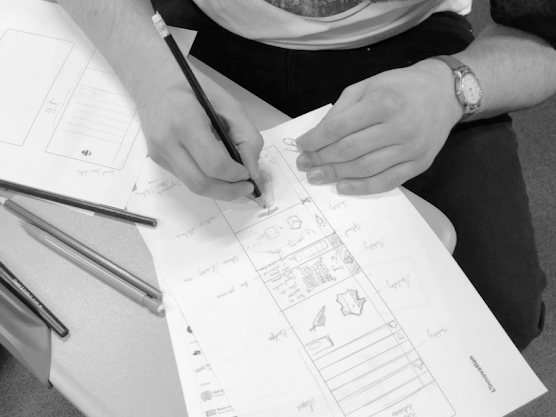
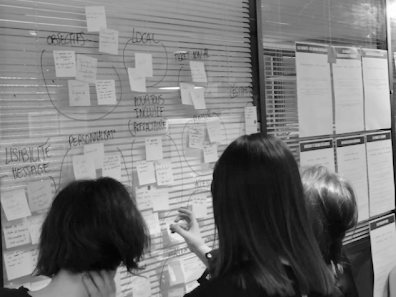
First day of the sprint: three participants sort sticky notes on the wall, around themes such as local food and how readable the message is Second day of the sprint: the “Solutions sketch” wall, with numbered sketches of paper receipts and screens Third day of the sprint: a hand pencils the prototype’s screens
The design sprint, in 2019. The questions on the wall on day one, choosing the sketches on day two, the prototype drawn by hand on day three.
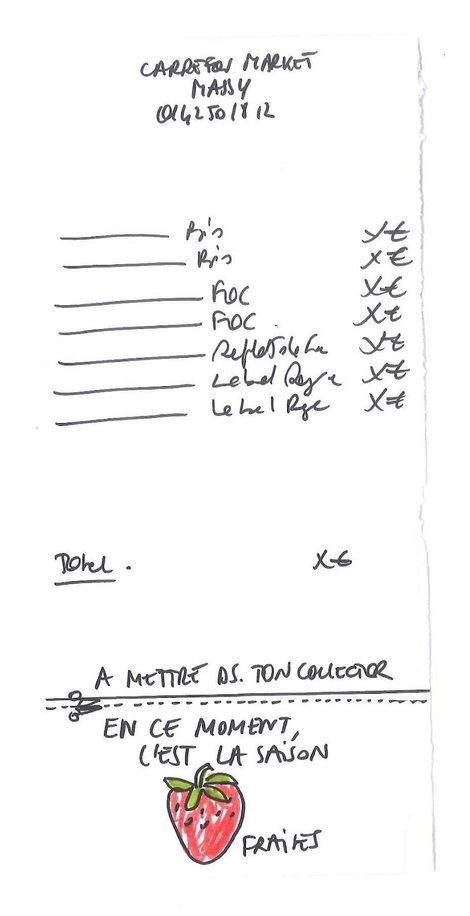
Receipt sketch: the list of items, then “Put it in your calendar: it’s strawberry season right now”
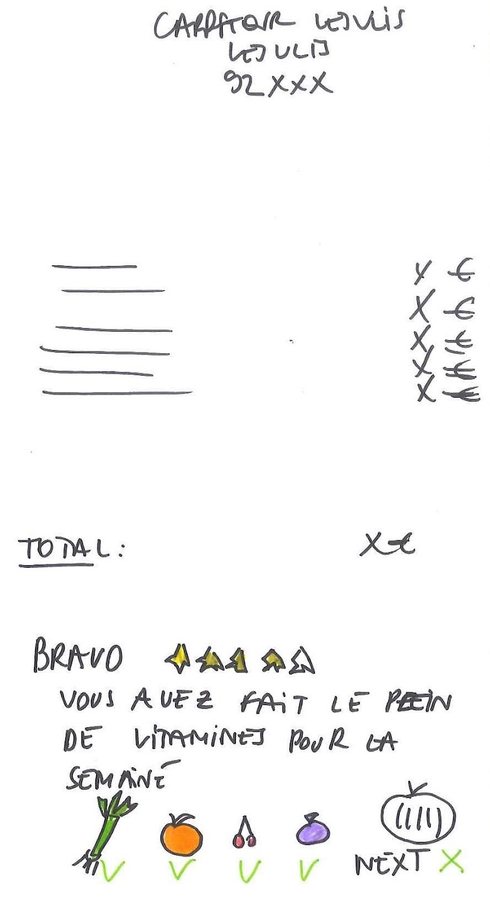
Receipt sketch: under the total, “Well done, you’ve stocked up on vitamins for the week”, with stars and ticked-off fruit and vegetables
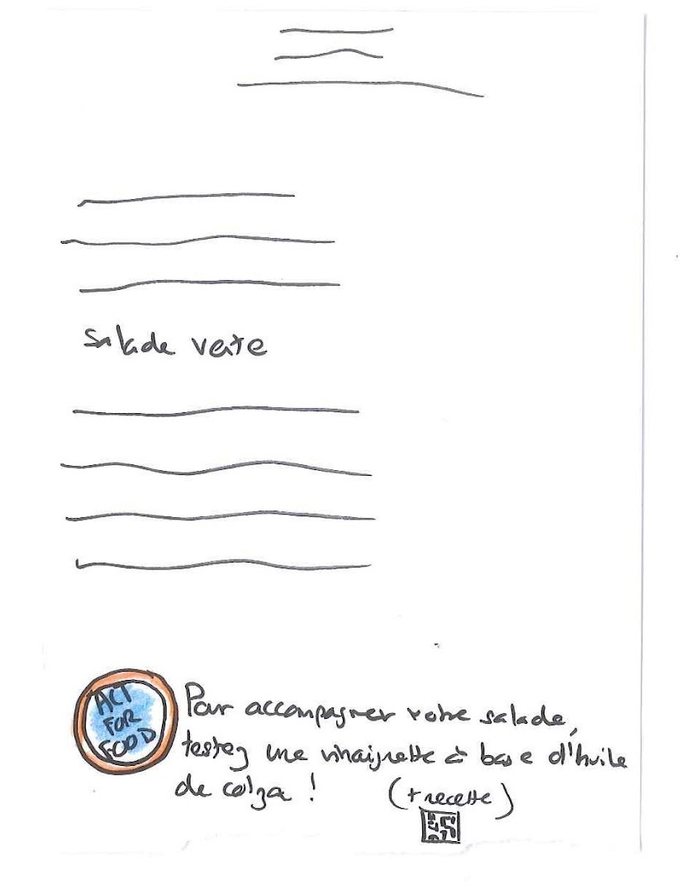
Receipt sketch: under the green salad bought, the Act for Food logo and “To go with your salad, try a rapeseed oil vinaigrette! (+ recipe)”, with a QR code
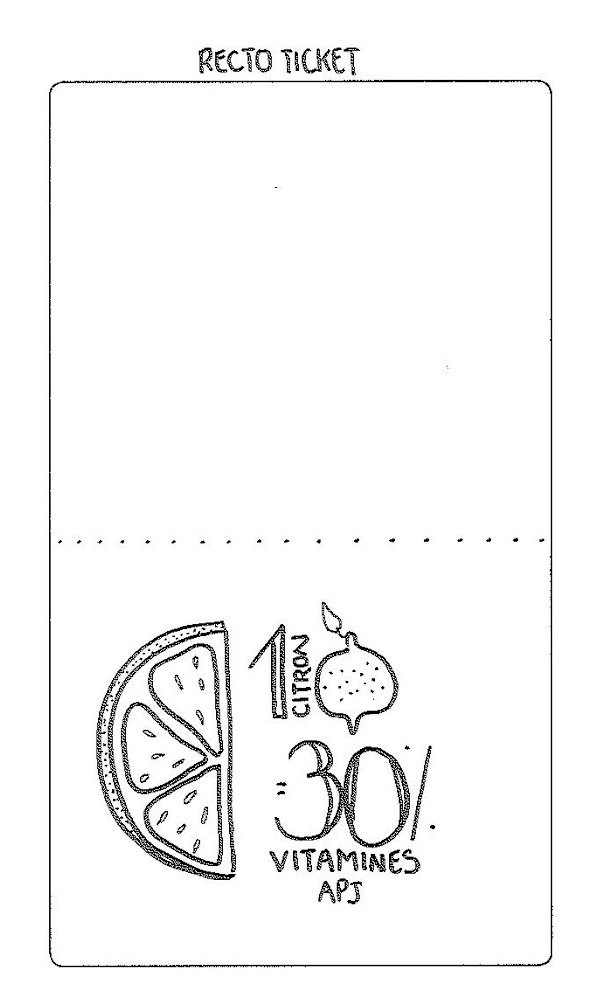
Sketch of the back of a receipt: a lemon and “30% of vitamins”
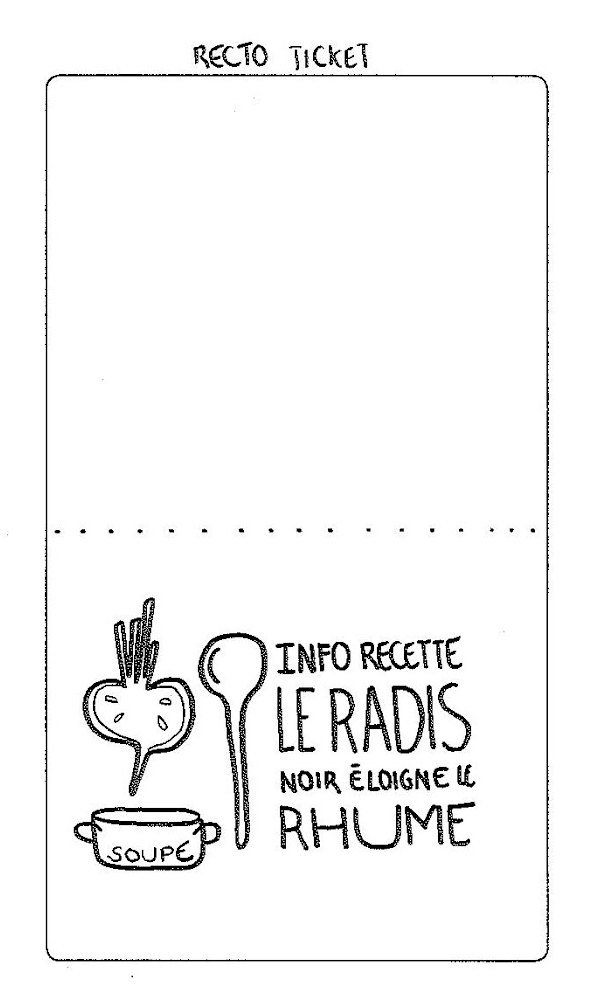
Sketch of the back of a receipt: “Recipe info: black radish keeps colds away”, with a bowl of soup
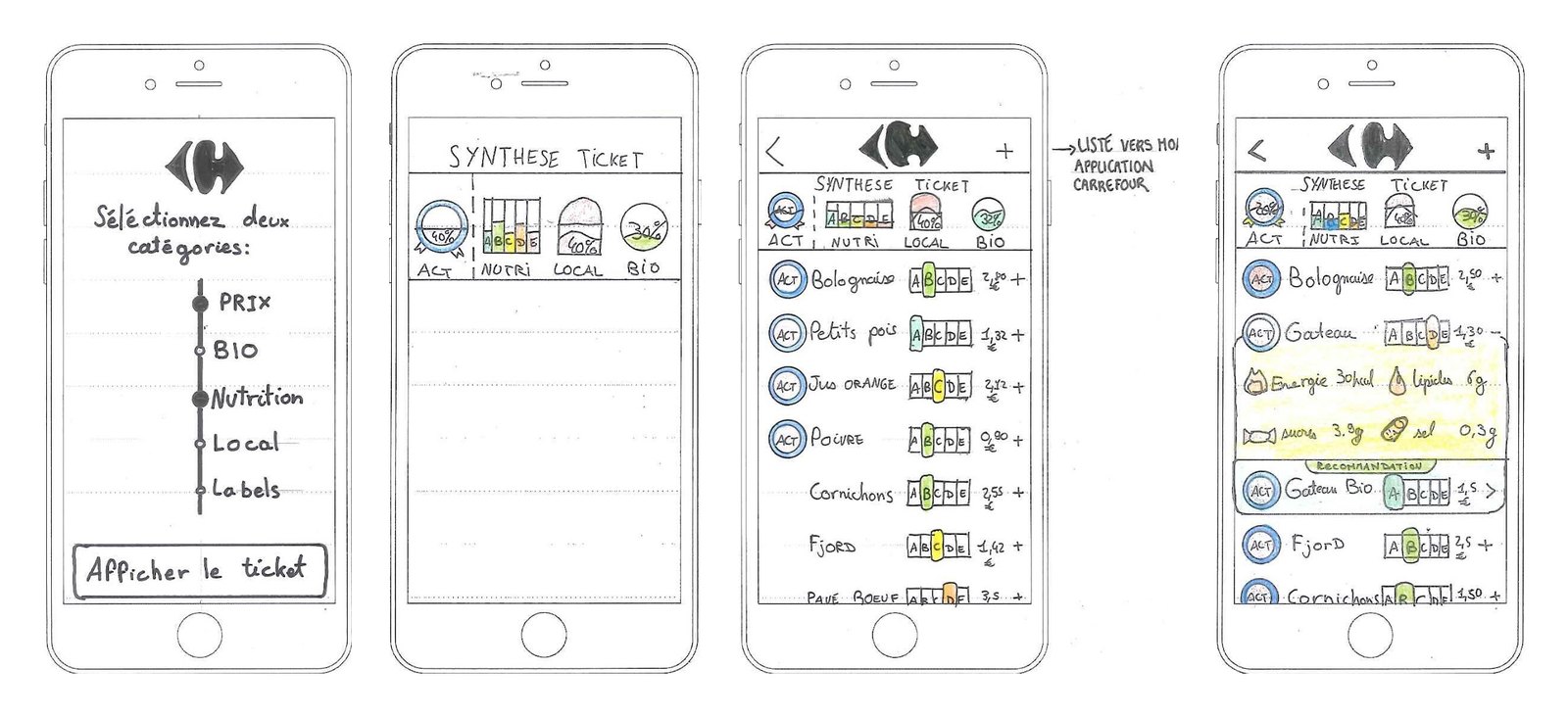
Four app screens drawn on paper: choosing two categories (price, organic, nutrition, local, labels), then the receipt summary, the list of rated products and a product detail with a recommendation

The sprint sketches. The bottom of the receipt on day two, then the backs of the receipt and the app screens on day three.

2026: the redesign

The project stopped before it was rolled out: no sponsor, no say over the Carrefour app’s roadmap, and product data (more than 100,000 items per hypermarket) that suppliers were reluctant to share. In 2026, I took the app up again on my own, as its 2019 design no longer reflected my level: a new design, checked content (Ciqual, Manger Bouger) and a complete design system in Figma, with 101 screens and their states. This version has not yet been tested with users.

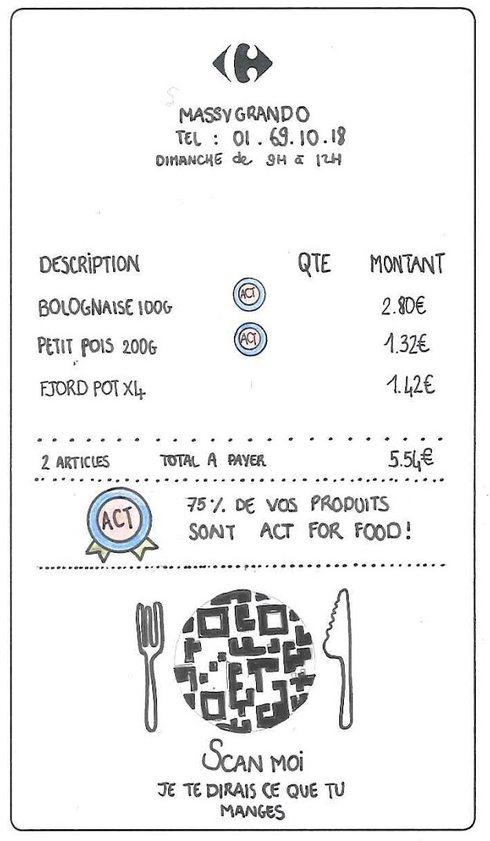
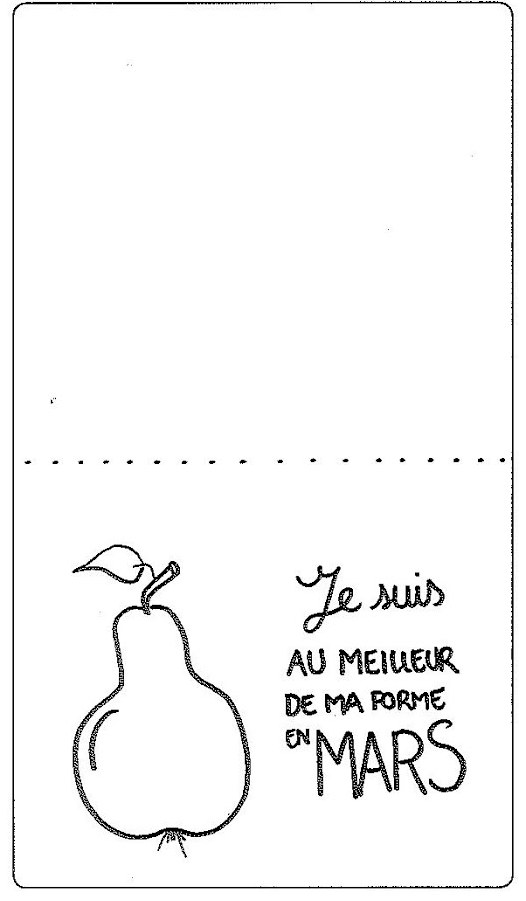
Here are the 2019 receipt and screens, next to what they became in the redesign. The receipt is the sprint sketch. The screens were redrawn in 2026 with the sample receipt.

2019
Sketch of the 2019 receipt, front: three items, “75% of your products are Act for Food!” and a QR code “Scan me, I’ll tell you what you eat” Sketch of the 2019 receipt, back: a pear and “I’m at my best in March”
2026
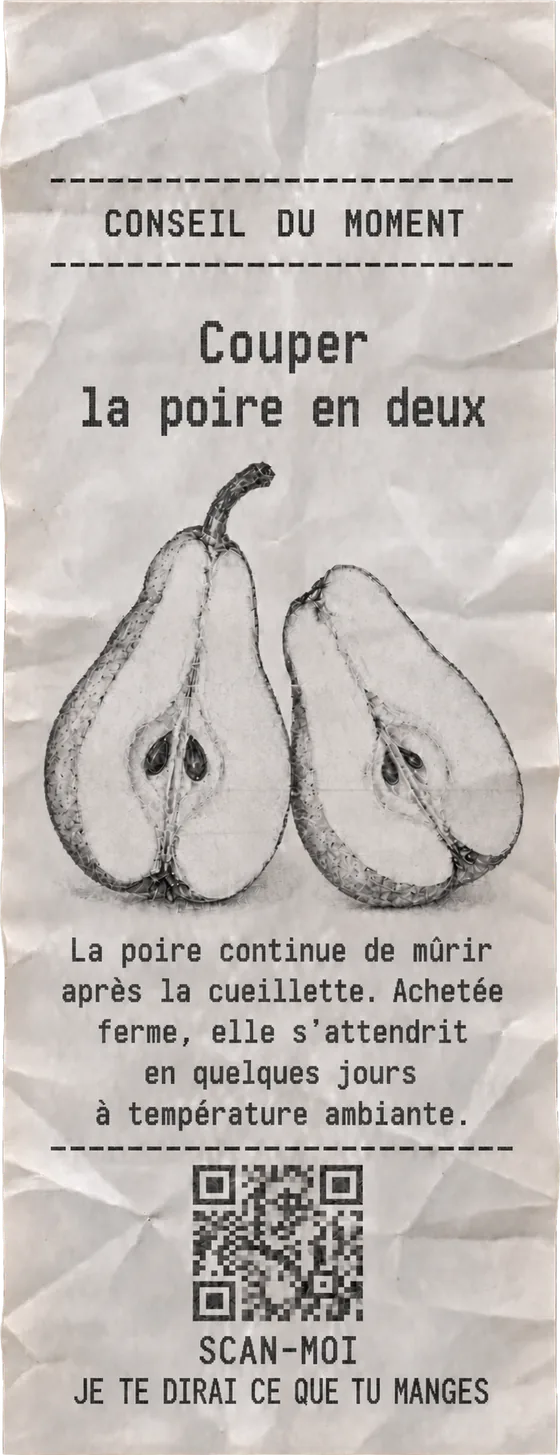
Back of the receipt in 2026: “Couper la poire en deux” (splitting the difference, literally cutting the pear in two), a tip for ripening it and a QR code “Scan me, I’ll tell you what you eat”
The paper receipt. In 2019, the front showed the share of Act for Food products and a QR code; the back, a seasonal pear. In 2026, the back keeps the pear and the “Scan me”, with a tip for ripening it.
2019
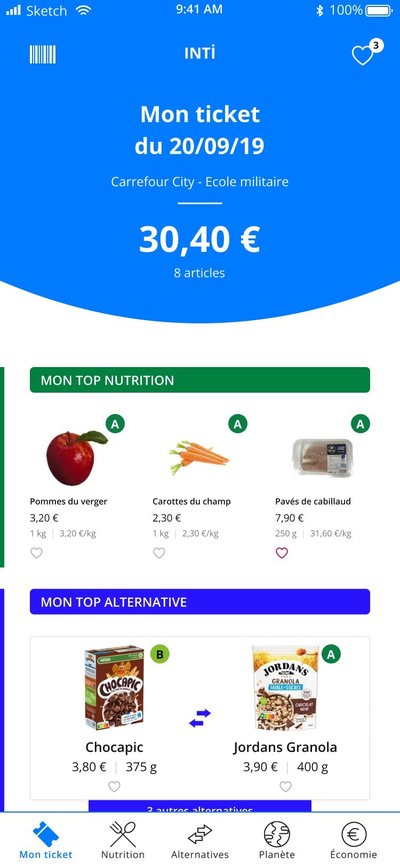
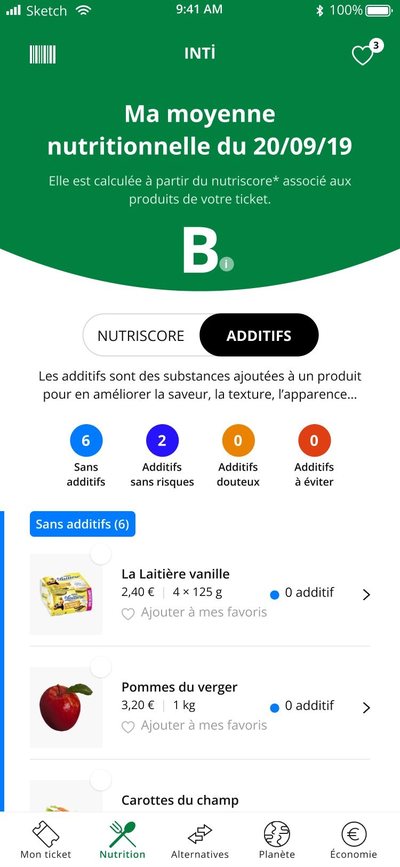
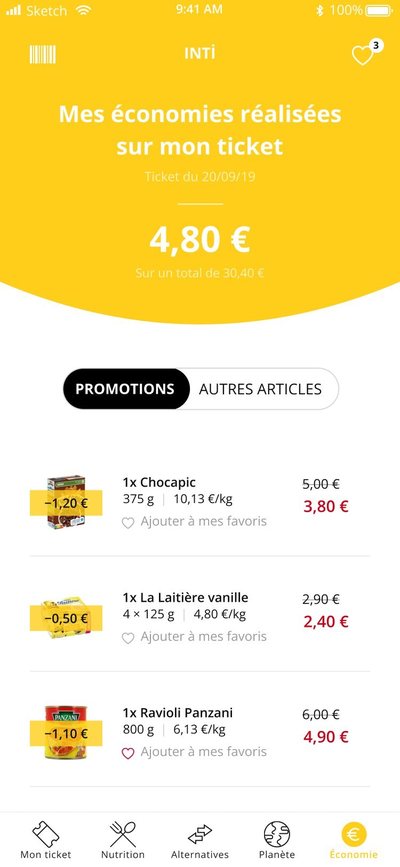
The 2019 My receipt screen, redrawn with the 20 September receipt: the €30.40 total, then the best products and the alternatives The 2019 Nutrition screen, redrawn: the receipt’s B nutrition average, the Additives tab and the additive-free products The 2019 Savings screen, redrawn: €4.80 saved on the receipt and the list of promotions
2026
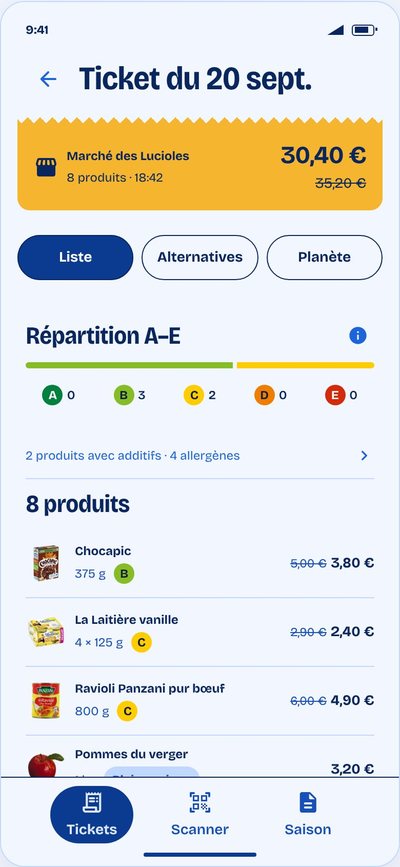
The 20 September receipt in 2026: the A to E breakdown, additives and the list of products with their struck-through prices
The receipt. In 2019, nutrition and savings each had their own tab. In 2026, the open receipt brings together the A to E score, additives and struck-through prices.
2019
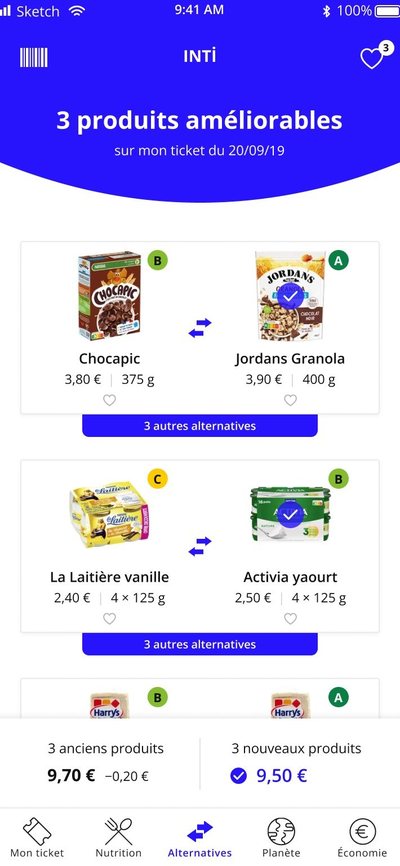
The 2019 Alternatives screen, redrawn: three products that could be improved, for example Chocapic rated B replaced by Jordans Granola rated A
2026
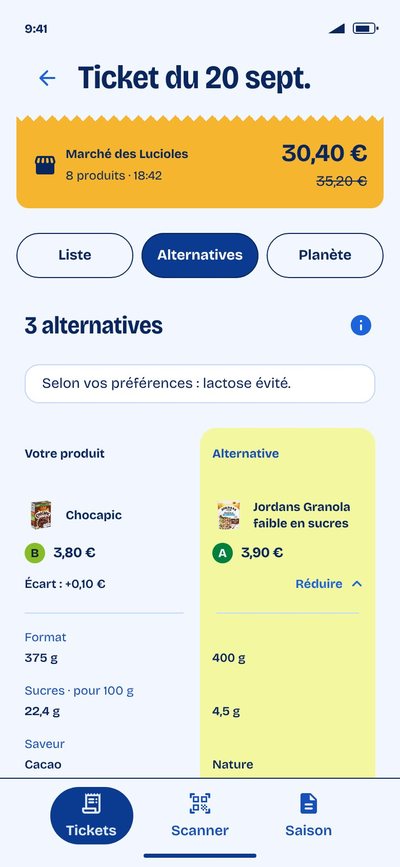
Alternatives in 2026, based on preferences (lactose avoided): Chocapic compared with a low-sugar Jordans Granola, with the price difference, pack size and sugars
Alternatives. In 2019, one product against a better-rated one. In 2026, the alternative follows your preferences (here, lactose-free) and gives the price difference.
2019
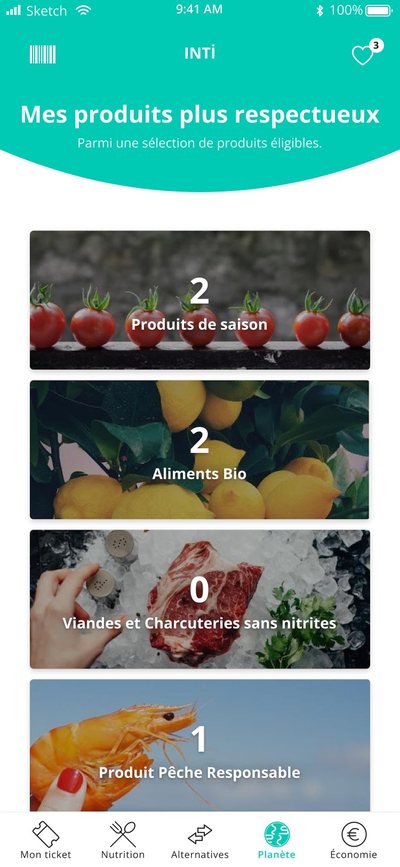
The 2019 Planet screen, redrawn: one photo tile per label, such as seasonal, organic or responsibly fished products
2026
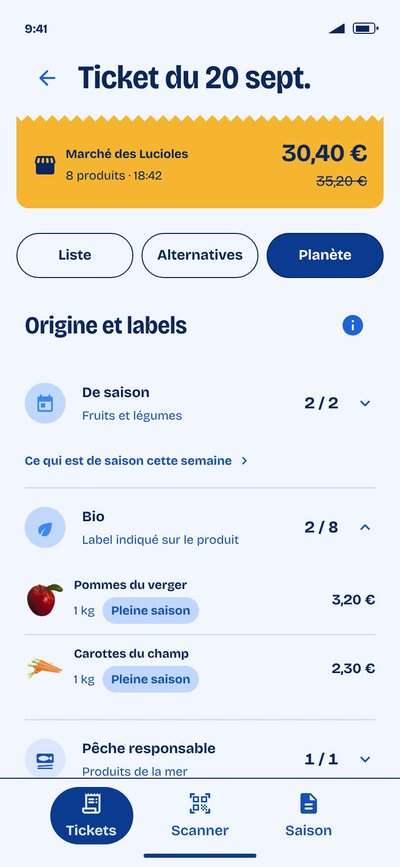
Planet in 2026: origin and labels, with the Organic label expanded on the 2 products out of 8 on the receipt that carry it
Planet. In 2019, one photo tile per label. In 2026, a list that relates each label to the products on the receipt, for example 2 out of 8 organic.
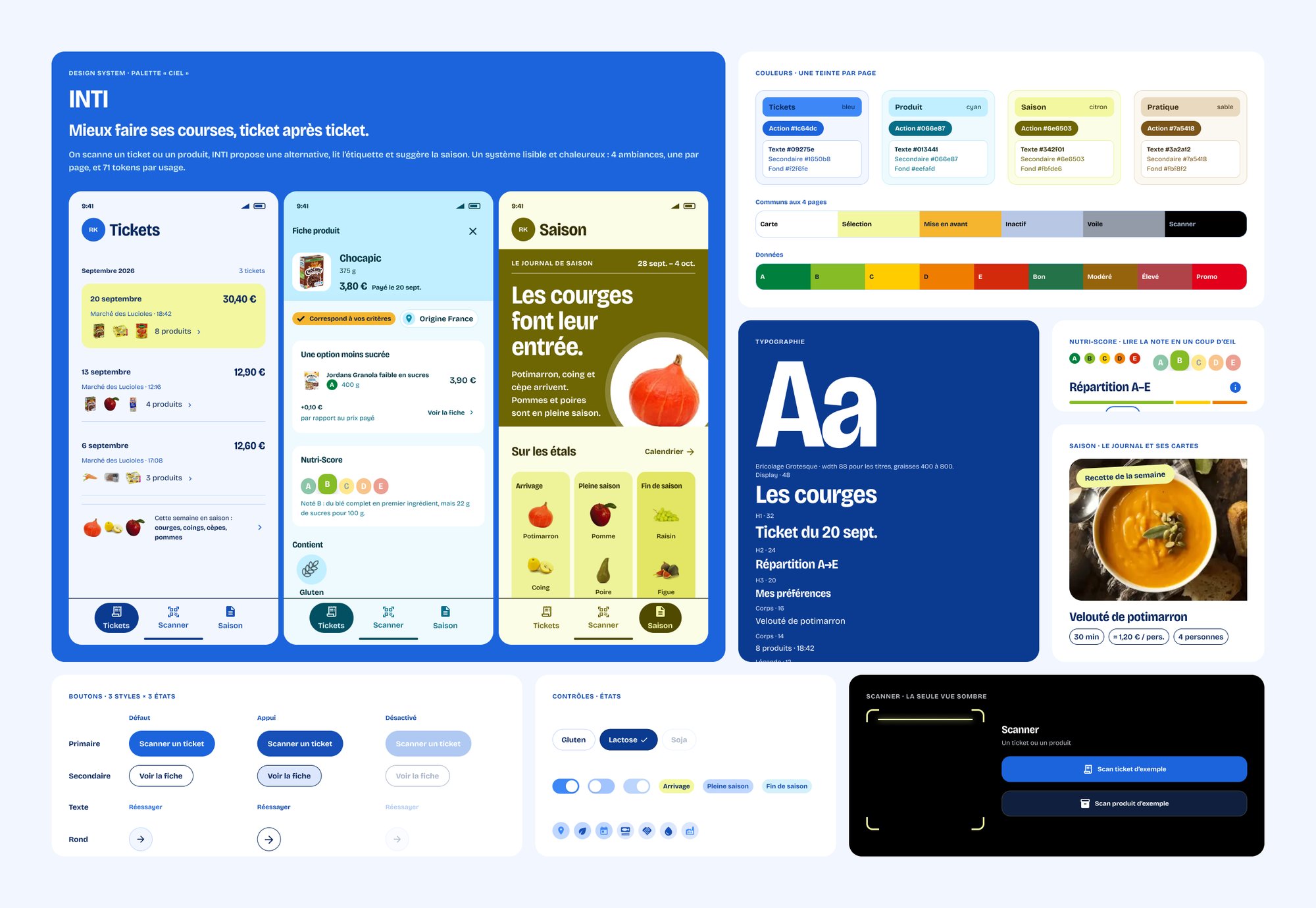
INTI design system board: three screens, four colour themes, typography, Nutri-Score, buttons, controls and scanner
The design system: one colour per space (Receipts blue, Product cyan, Season lemon, Practical sand), 71 tokens, 333 components.

04Trade-offs

Design choices, and what they ruled out

One level, one tester remark

  1. The paper receipt

    On the back of the receipt, a “Conseil du moment” (tip of the moment): a seasonal product, an engraving, and a tip for choosing, storing or cooking it.

    WhyIt is the only level you can read without a phone or any effort. In 2019, testers said they almost never scanned QR codes, so the tip had to be worth something on its own.

    TodaySince 2023, receipts in France are no longer printed by default. The tip would come with the emailed receipt, the retailer’s app or the receipt printed on request. As early as 2019, we were exploring email and SMS alongside the QR code.
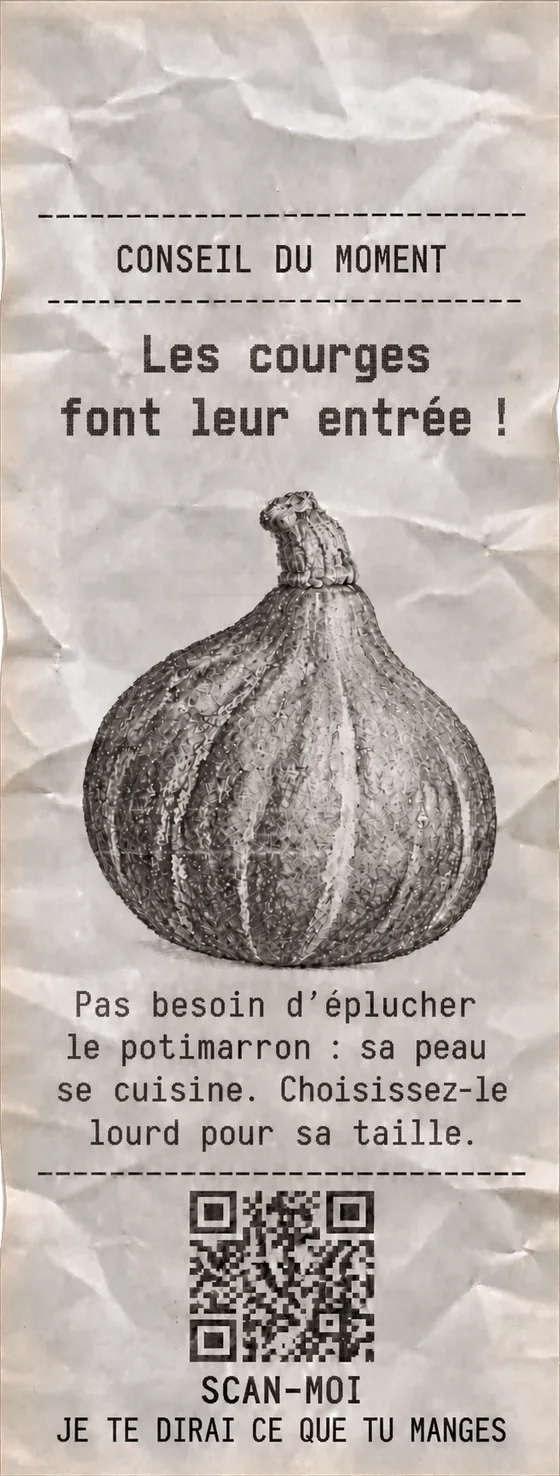
Receipt “Les courges font leur entrée !” (squash season is here), with an engraving of a red kuri squash. Tip: no need to peel a red kuri squash, its skin can be cooked. Pick one that feels heavy for its size.
Receipt “Couper la poire en deux” (literally cutting the pear in two, meaning splitting the difference), with an engraving of a halved pear. Tip: pears keep ripening after picking. Bought firm, they soften in a few days at room temperature.
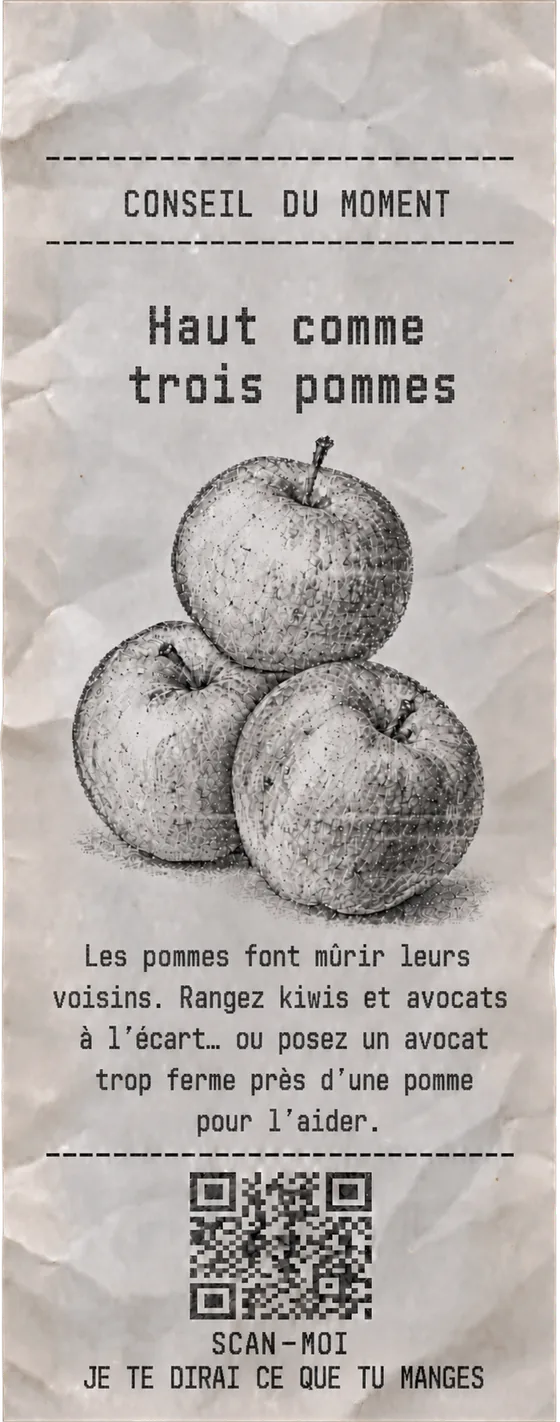
Receipt “Haut comme trois pommes” (literally as tall as three apples, meaning knee-high), with an engraving of three stacked apples. Tip: apples ripen their neighbours. Keep kiwis and avocados away from them… or put an underripe avocado next to an apple to help it along.
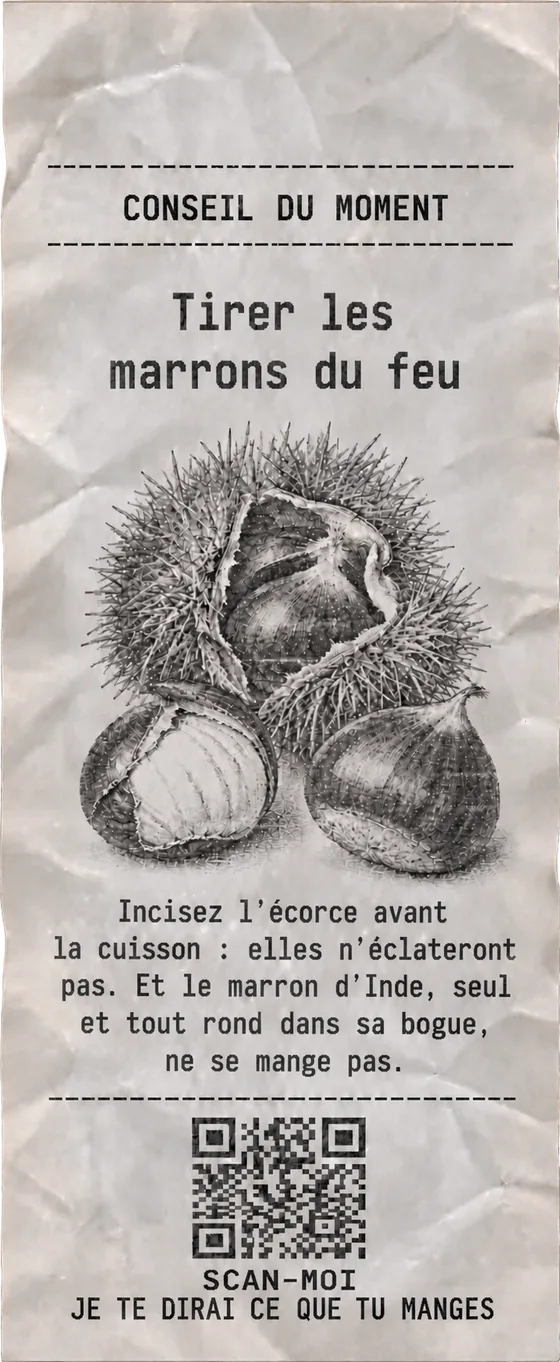
Receipt “Tirer les marrons du feu” (literally pulling the chestnuts out of the fire, meaning doing the hard work for someone else’s benefit), with an engraving of chestnuts and their husk. Tip: score the shell before cooking so they don’t burst. And the horse chestnut, alone and perfectly round in its husk, is not edible.
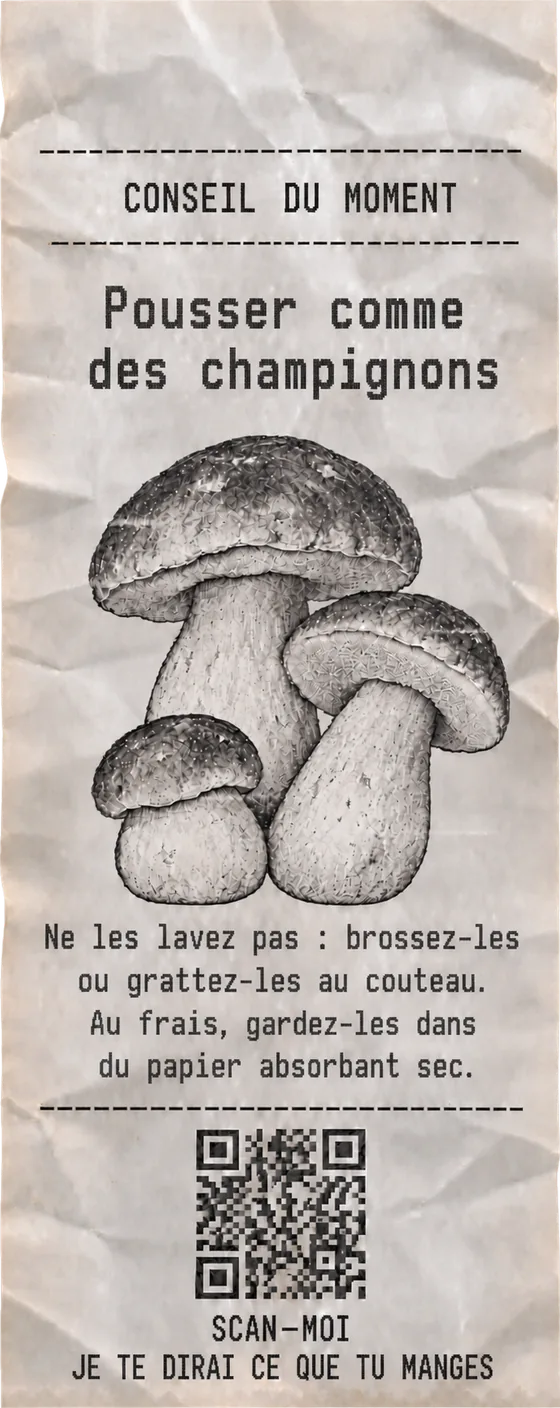
Receipt “Pousser comme des champignons” (literally growing like mushrooms, meaning springing up overnight), with an engraving of three porcini. Tip: don’t wash them, brush them or scrape them with a knife. In the fridge, keep them in dry kitchen paper.
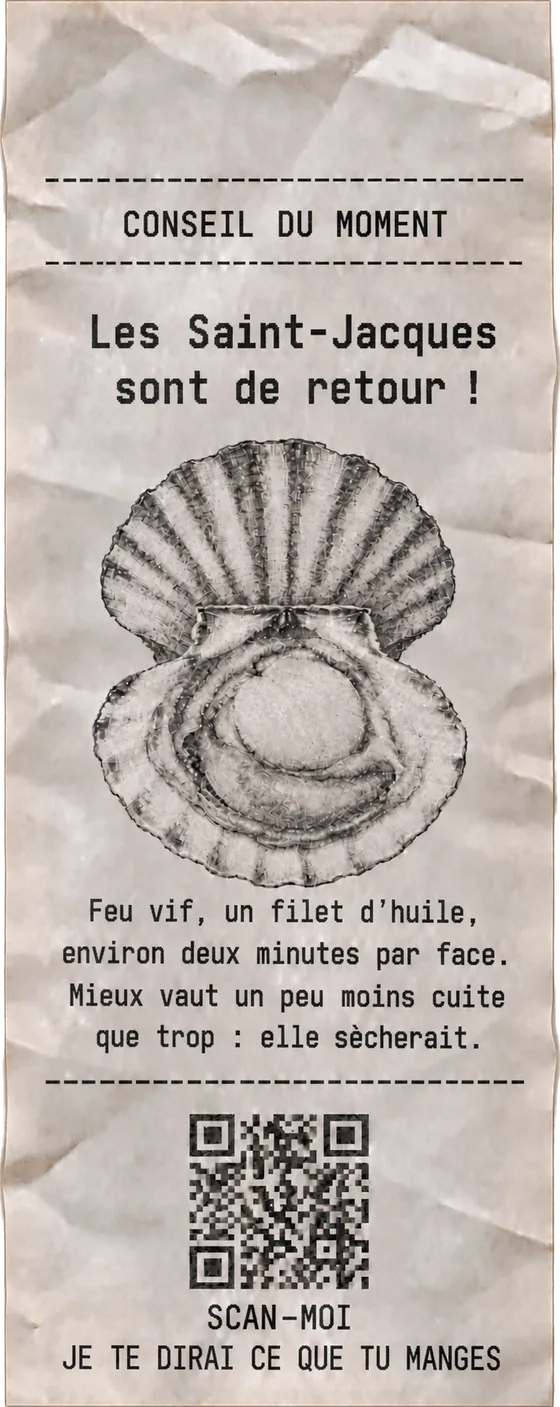
Receipt “Les Saint-Jacques sont de retour !” (scallops are back), with an engraving of an open scallop shell. Tip: high heat, a drizzle of oil, about two minutes per side. Better slightly undercooked than overdone, or it dries out.
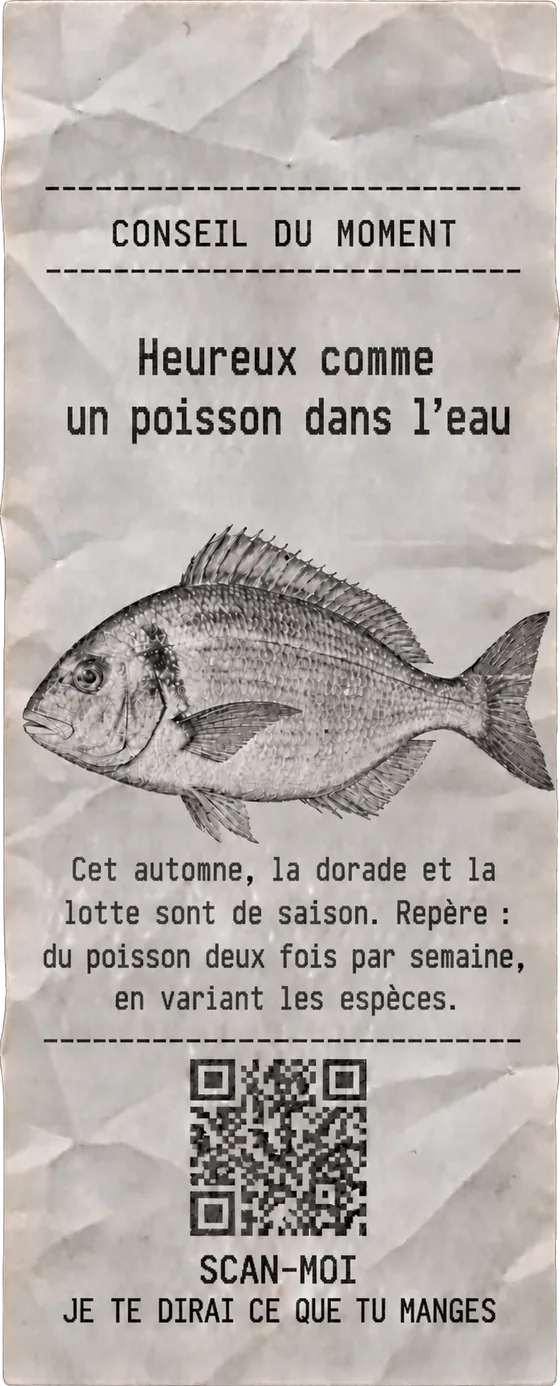
Receipt “Heureux comme un poisson dans l’eau” (happy as a fish in water, meaning in your element), with an engraving of a sea bream. Tip: this autumn, sea bream and monkfish are in season. Rule of thumb: fish twice a week, varying the species.
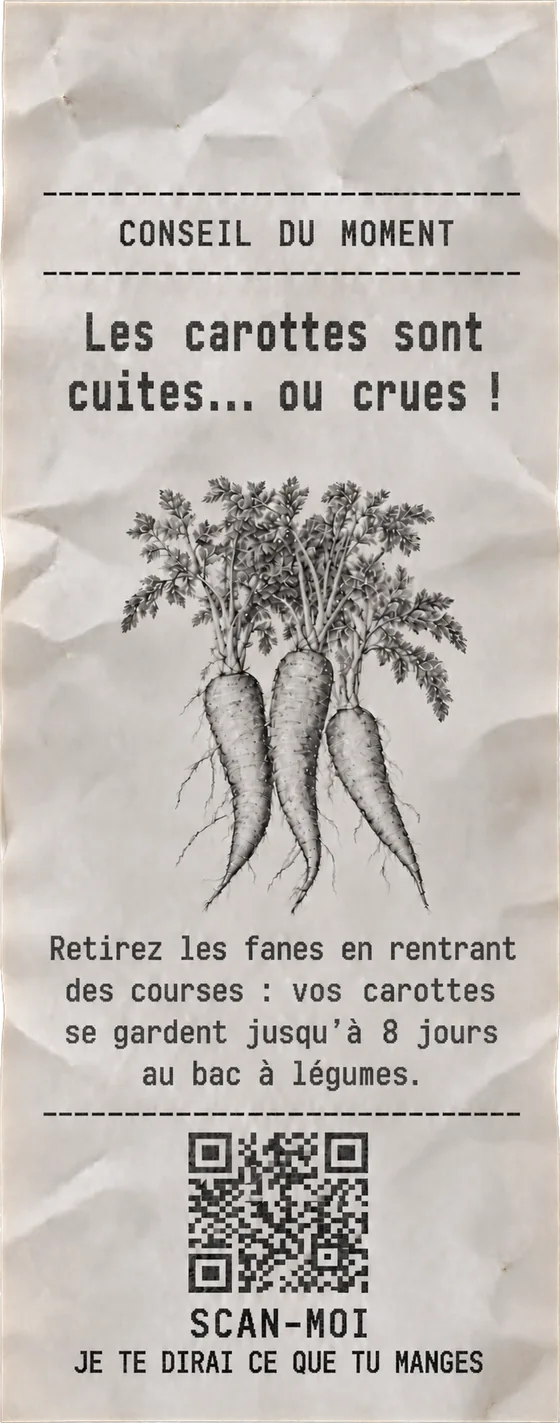
Receipt “Les carottes sont cuites… ou crues !” (a play on “the carrots are cooked”, meaning it’s all over: cooked… or raw!), with an engraving of a bunch of carrots with their tops. Tip: remove the tops when you get home, and your carrots keep for up to 8 days in the vegetable drawer.
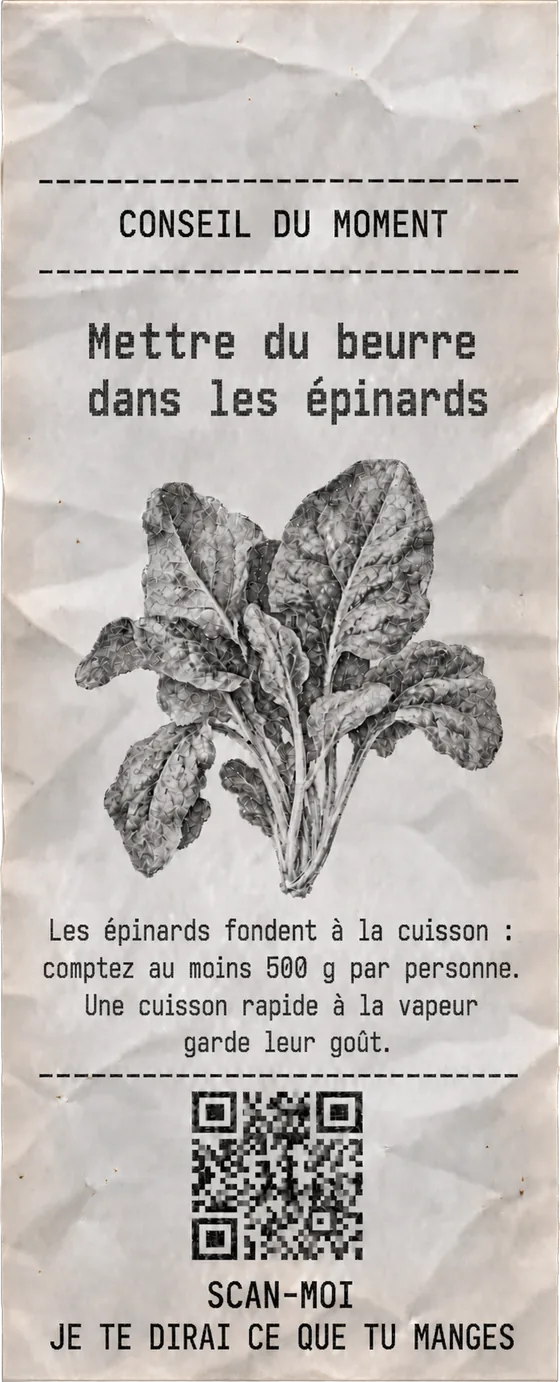
Receipt “Mettre du beurre dans les épinards” (literally putting butter in the spinach, meaning making life a bit more comfortable), with an engraving of a bunch of spinach. Tip: spinach shrinks a lot when cooked, so allow at least 500 g per person. Quick steaming keeps the flavour.
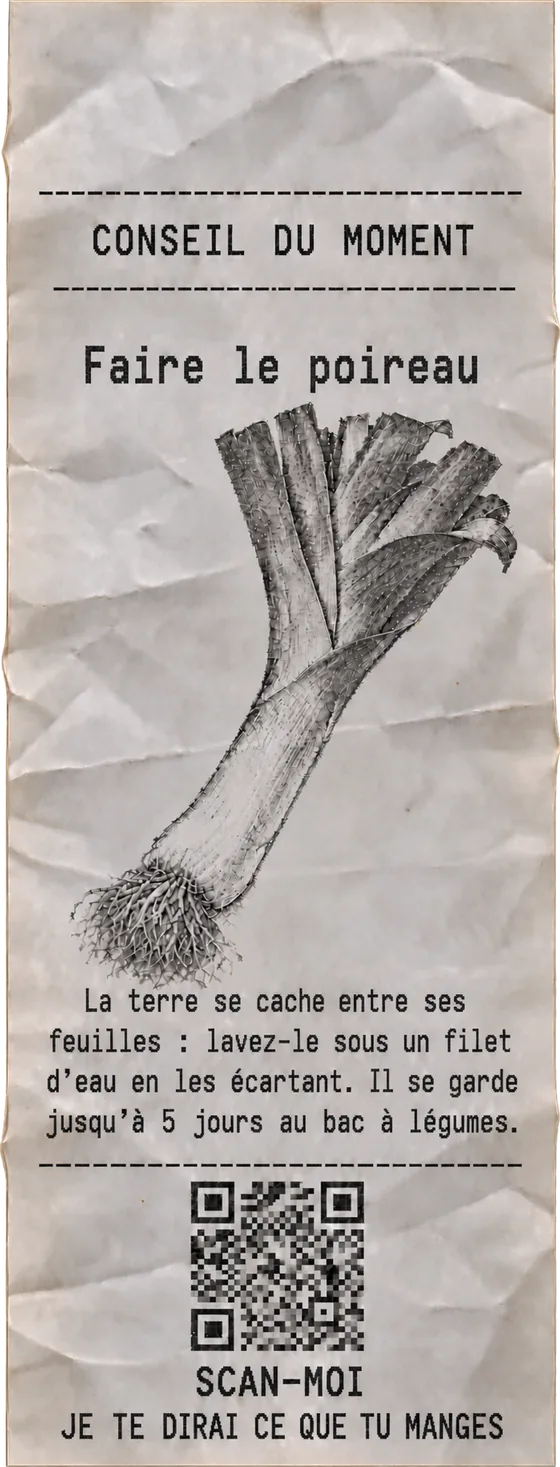
Receipt “Faire le poireau” (literally doing the leek, meaning being kept waiting), with an engraving of a leek. Tip: soil hides between its leaves, so rinse it under running water while spreading them. It keeps for up to 5 days in the vegetable drawer.

Hover over a receipt to straighten it.Swipe to see all ten receipts.

  1. The receipt in the app

    One scan of the QR code, and the receipt opens in the app: the products bought, their prices, and the breakdown of Nutri-Scores from A to E.

    WhyEverything starts from the receipt, and testers singled this out as a strength.

    “I don’t have to scan the products one by one […], it’s linked to my receipt.”Sprint test, 2019

  2. Alternatives

    For a product bought, a better-rated alternative with the price difference, taking preferences into account (allergies, organic, origin).

    WhyPeople only follow an alternative if the price works. So the difference is always shown, and the alternative stays a mere suggestion.

    “Earlier it was the same price, now it’s more expensive, so I’m not sure I’ll follow the recommendation.”Sprint test, 2019

  3. Planet

    What the receipt says about the environment, in simple markers: seasonal, organic, responsibly fished, palm-oil-free, counted across the receipt.

    WhyPlanet sticks to the facts, without adding a score. Origin and local sourcing were the information testers valued most.

    “Knowing the origin, I’m very much into local, I like knowing where things come from.”Sprint test, 2019

  4. La Saison

    A weekly magazine: what’s arriving on the stalls, baskets by budget, recipes and tips.

    WhyCommenting on purchases already made comes too late. La Saison gives advice before the next shop, and even outside it.

    “Once I’ve been through the checkout, it’s too late.”Sprint test, 2019

Across the app

kept

No mandatory account

Because a tester warned us in 2019: “I’ll scan, unless I have to sign up”. So scanning is all it takes: receipts stay on the phone, and an account with no password is only used to back them up. Made mandatory, it would also have looked like data collection.

kept

A separate app, without the retailer’s brand

Because one question kept coming up from the sprint onwards: is a retailer that rates the products it sells credible? So INTI was designed outside the Carrefour app, which also let it move forward without waiting for that app’s roadmap.

kept

A page for every fresh product

Because fresh produce is judged differently. Its page gives its season, how to store it and ideas for cooking it.

dropped A Nutri-Score on everything, because of fruit, vegetables and fresh fish, which don’t have one.

dropped

Buying from the app

The 2019 version let you order, and we already had doubts about it. I removed it from the redesign because of the expectation it created: a half-possible purchase promises what the app cannot deliver.

05Lessons

What I take away

Don’t judge: give the information without imposing it. Each level reaches different people, with a stronger or weaker effect.

Eating better often costs more, and not every customer can keep up. An alternative only makes sense if it comes at several price points.

An information service is only as good as its data. Without a retailer willing to demand it from suppliers and invest in tracing it, it doesn’t hold up.

The retailer’s image cuts both ways. The same tip can read as a way to sell at a higher price, or as proof that the retailer is pushing its suppliers to produce better.

Next project
Flash — From the checkout queue to out the door in seconds →
↑ Back to top